Because arrival bias operates at a fundamental level, it has broad implications, including important lessons for molecular evolution, evo-devo, parallelism, and the structuralist agenda a la Kauffman. Taking these lessons into account would change the way we conduct research, think about causation, teach students, and interpret historic disputes.
That change clearly is not happening, even though arrival bias is now well established empirically. This failure to penetrate evolutionary thinking is not due to a lack of information— readily available via numerous publications, a book, blogs, videos, a Big Biology podcast, and a wikipedia page. Anyone who wants to understand arrival bias can just ask me. The number of times I have been asked by scientists to present arrival bias in the past decade can be counted on one hand.
The idea does not align well with foundational thinking about “forces” and causation, but my focus here is on a more superficial barrier that emerges from the way that scientists faced with novel claims tend to grasp for some immediate way to (1) dismiss it as untenable, or (2) file it in an existing category, so that it becomes yesterday’s news. Both solutions relieve the psychological stress of confronting an unknown issue that threatens to disrupt one’s prior beliefs.
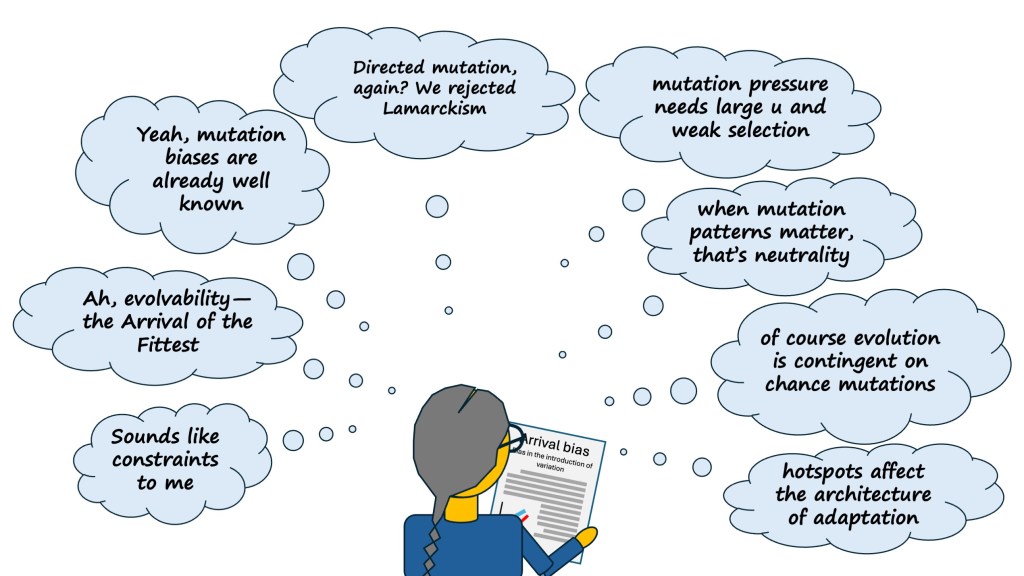
That is, misapprehension can be seen as a coping strategy for psychic dissonance. Scientists exposed to statements about arrival bias— statements with an uncertain significance— may file them away under:
- mutation bias
- neutrality (neutral evolution, random fixation, non-adaptive processes)
- contingency (chance, randomness in evolution)
- constraints (limits)
- mutation pressure
- adaptive mutation
- evolvability
- hotspots (mutational target size, mutational variability)
Misapprehension is encouraged by the combination of two powerful factors. The first one is that every trained evolutionary biologist has been taught that population genetics provides a theory of evolution covering the implications of selection, mutation and Mendelian inheritance. Readers with this belief will tend to assume that “arrival bias” is not a new theory, but an attempt to shift attention to something previously known but underappreciated.
Second, learning and integrating something new is difficult, painful, and time-consuming. If I want to digest just 1 scientific paper on a topic that is new to me, something outside my immediate area of expertise, it will take hours. I will wade into it and experience a feeling of unease (I don’t understand this; I can’t see where the argument is going), and I might experience disorientation from trying to grasp something that contradicts long-held views (is that actually true? do I really need to change how I’m seeing this?). Of course I can also experience the joy of discovery and mastery that comes from learning. But all that takes time.
And most scientists— even though they are smart, curious and engaged— are busy and do not have time and energy to evaluate every allegedly new idea that comes along. So, they triage claims of novelty, and the triage process is measured in seconds, not hours, like the way that we triage email messages in the inbox. The reaction to arrival bias might be the same as the reaction to an email request to help a Nigerian royal transfer a very large inheritance to an overseas bank. The potential payoff is huge, yet we immediately click “delete”— without doing any research into the facts— on the assumption that it cannot be what it seems to be. We judged that book by its cover, then moved on. We desk-rejected it, without review.

This is why misapprehension cannot be combatted by throwing books and papers at it: the people who need to be reached have already decided that the idea is not worth the time it takes to read a blog, much less a paper or a book. They won’t read this blog either.
Instead, this blog is to help early-adopters (1) understand this phenomenon of misapprehension and (2) solidify their own grasp of what makes arrival bias distinctive— both for their own understanding, and so that they can share that distinctiveness with busy colleagues. I will go through each of the misapprehensions above and explain why it is appealing and yet wrong.
By the way, I’m not focused on proving that these misapprehensions exist. Misapprehensions appear in anonymous reviews and online reactions, but not typically in peer-reviewed publications, because the scientists who desk-reject arrival bias typically don’t find it worthy of their precious time. The exception is the case of gate-keepers, who deliberately spend time explaining to readers why something isn’t important or novel. For instance, Lynch (2007) cites two key sources on arrival bias, mis-describing them as advocacy of “mutation pressure” acting as a “driver”. Then he explains the conditions for the efficacy of mutational effects using a model that relies on random fixation of slightly deleterious alleles, utterly missing the point. Svensson and Berger (2019) associate arrival bias with neutrality, contingency, constraints, mutational variability (heterogeneity), evolvability, and adaptive mutation. That is, they run through the full gamut of misapprehensions, because they want to make sure their readers absorb the lesson that arrival bias is not a threat to traditional beliefs.
Mutation bias
Scientists who believe that evolutionary theory is already complete may interpret claims about arrival bias as attempts at re-branding, i.e., drawing attention to a role of mutation biases that is already known but under-appreciated. They may respond to claims of arrival bias by saying “we have long known that mutation rates are not all the same.”
The distinction is easy to explain. Mutation bias is a phenomenon of genetics— something you might learn about in a course on genetics, molecular biology, or genomics— whereas arrival bias is a phenomenon of population genetics. Mutation biases can happen without inducing arrival bias, e.g., if all the relevant alleles are already present at substantial frequencies, mutational interchanges between the alleles may be biased without inducing a bias in arrival. Likewise, arrival biases can happen without mutation biases, e.g., if the bias in introduction is imposed at the level of phenotypes via development, or if the events of introduction are events of migration.
The theory of arrival bias, which explores the implications of mutation biases for evolution, is a new theory introduced in 2001. A key implication, not found in prior thinking, is the potential for mutation-biased adaptation. The theory of arrival bias is not found in the work of Haldane, Fisher and Wright, and plays no role in the major claims of the Modern Synthesis. It is not covered in your population-genetics textbook, nor in the Oxford Encyclopedia of Evolution (2002), nor the Princeton Guide to Evolution (2013)— described by the publisher as “The essential one-volume reference to evolution”.
Neutrality (neutralism, drift)
Arrival bias has nothing to do with neutrality and does not depend on drift. Imagine a simple model of one-step adaptation with 2 options that arise by rare mutations, one option with 20 % more fitness benefit, but both so strongly beneficial that either one will be fixed almost immediately after it arises. Which one gets fixed first? The one that arises first. That’s arrival bias with no drift.
So, how does this association with neutrality arise? The reason does not have to be make sense: remember, the people who desk-rejected arrival bias didn’t bother to understand it— they are merely guessing. Why do they guess neutrality? I think it is because so many scientists think of evolutionary genetics in terms of a dichotomy of two regimes, a deterministic regime ruled by selection, and a neutral regime in which mutation biases matter. Under this hybrid view, the observation of mutation-biased evolution is an indication of neutrality. That is, for those whose thinking is informed by a neutralist-selectionist dichotomy, claims about mutation-biased evolution look like they belong in the “neutral” category.
Contingency (chance)
The state of an evolving system at time t depends on the state at t – 1 and on the intervening dynamics. This may seem obvious today, but it was not obvious to previous generations of thinkers, who tended to see evolution as the kind of process that proceeds inevitably to a predictable outcome regardless of the details of history, e.g., this is explicit in the defense of adaptationism by Reeve and Sherman (1993).
“Contingency” is the word that we use to signal a rejection of the quasi-deterministic “equilibrium” view, and instead draw attention to the chancy dependence of evolutionary outcomes on the details of history. Because “contingency” is defined by the negation of an ideal, the notion isn’t coherent: just as there is not a coherent category of “non-fungi” or “observations that prove the earth isn’t flat”, contingency does not point to a coherent category.
So, one could read everything S.J. Gould and other authors have written about “contingency”, and yet fail to grasp arrival bias or anticipate its effects. For instance, Mani and Clarke (1991) developed a model that could be described as population divergence contingent on mutational order, and this helped to spawn a larger body of literature on “mutation-order speciation”, but this is about how “chance” or “randomness” contributes to divergence, not about how biases in variation are transmitted to evolution. Both effects of random arrival order and effects of biased arrival can be placed into the category of contingency, but only one of them is arrival bias.
Constraints (limits to adaptation)
Roughly speaking, a constraint is some factor that influences evolution, where that influence can be understood as a limit or restriction on selection or adaptation, rather than as a cause in its own right. The idea of variation as a “constraint” rose to prominence in the 1980s as a compromise to satisfy two different constituencies, the evo-devo pioneers who insisted that development importantly shapes or directs evolution, and the traditionalists who insisted that selection is the prime mover and the only source of direction in evolution. “Constraint” was the version of “development matters” that both sides could accept. Because the term is vague and does not specify a mechanism, it is easy to accept “constraints” as inevitable, and then to dismiss them as relatively unimportant and uninteresting.
The evo-devoists eventually revolted against the purely negative implication of “constraint”, and began to talk about “deconstraint” or “developmental bias”. However, in the absence of a research program that clarifies the theoretical and empirical foundation for a major falsifiable claim about how development shapes evolution, this shift in language sounds like creative re-packaging or re-branding, rather than a genuine scientific achievement.
Thus, the situation with “constraint” is analogous to that with “contingency”: one could read the classic Maynard Smith, et al (1985) paper on “developmental constraints”, or any subsequent evo-devo work, and fail to understand arrival bias. One of them is about patterns in which the details of development seem to matter for understanding the outcome of evolution, and the other specifies a mechanism of variational influence (at the population-genetic level) that may have important implications for evo-devo.
Mutation pressure
The classic meaning of mutation pressure in population genetics is the mass-action effect of recurrent events of mutation on the frequency of an allele. For instance, the balance between upward mutation pressure and downward selection pressure is what keeps some alleles for genetic diseases at relatively constant non-zero frequencies. Mutation pressure also can drive an allele from low to high frequency, but this depends on the absence of opposing selection and it happens very slowly, on the order of 1/u generations, so it is only important for edge-cases like the loss of complex traits under relaxed selection (e.g., cave-fish eyes).
The appeal of “mutation pressure” is that it seems like a catch-all term to cover any predictable or systematic effect of some type of mutation (e.g., the usage of Lynch 2007 mentioned above). If “mutation pressure” means “systematic effect of mutation” then arrival bias falls into that category, but the problem is then like the problem with “constraint” and “contingency”: if we use these terms loosely, applying them to arrival bias does not help us to understand arrival bias or its implications. Another way of saying this is that we could read everything that Haldane, Fisher and Wright wrote about mutation pressure, and not learn anything about arrival bias.
Adaptive mutation
The theory of arrival bias promoted in key publications can be applied in many ways, but the core of the theory is a population-genetic mechanism in which the rate of origination of new variants imposes a prior bias on their chances of contributing to evolution. The theory follows from a specific type of causal link between inputs and outputs, and is not loaded up with prior assumptions about either (1) the nature of the variational inputs, or (2) the nature of the ecological, physiological, or phylogenetic outputs. In a hypothetical universe with no mutation biases, the theory would be the same, it just wouldn’t be useful.
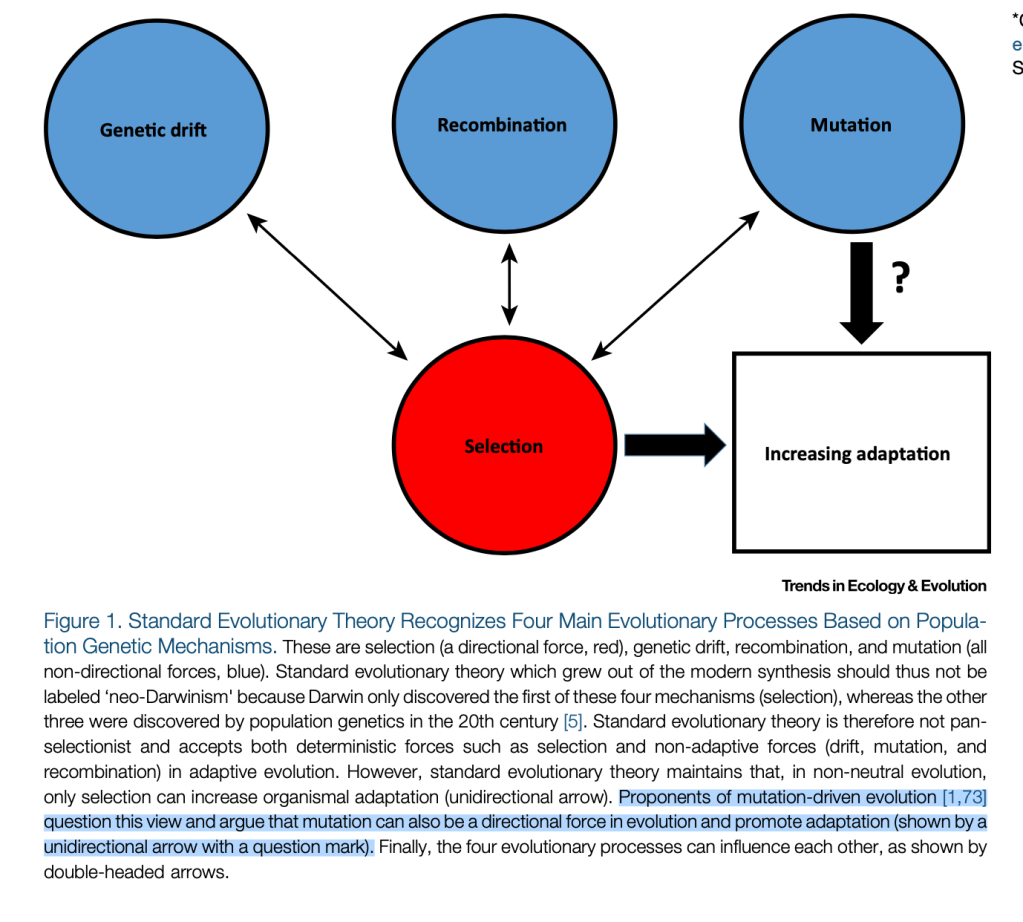
Why then do claims of arrival bias make people think of adaptive or directed mutation? Presumably it is because they have been taught that selection acting on random variation is the source of direction in evolution, and that the only alternative to this theory is a quasi-Lamarckian theory in which mutations are “directed” toward adaptation. They hear claims about “bias” or “direction” and they assume that must refer to a bias in fitness or an adaptive direction, as in the figure below from Svensson and Berger (2019). Instead, to understand arrival bias, one must think about a bias in trait-space defined independently from fitness effects.
Evolvability, the arrival of the fittest
Andreas Wagner wrote a book called “The Arrival of the Fittest” in which he claimed to solve “evolution’s greatest puzzle”. Surely, “arrival bias” and “the arrival of the fittest” are both about “evolvability”, right?
No, only one of them is, and the distinction is right there in the words. Arrival bias is about the arrival of mutationally and developmentally likelier forms, not necessarily fitter forms. For instance, in the GP (genotype-phenotype) maps literature, there is an effect called “phenotype bias” by which some phenotypes have vastly more genotypes, i.e., they account for more of the volume of genotype-space. This makes them more likely to be found by mutation, which makes them more discoverable (evolutionarily) via an “arrival of the frequent” effect. There is now abundant evidence that, due to the arrival of the frequent, RNA folds that are common in genotype-space are common in nature. This doesn’t mean they are the best folds, but that they are the most common folds in genotype-space, easily found.

By contrast, when Wagner and others refer to the arrival of the fittest (and more generally, when researchers refer to “evolvability”) they mean to put the focus on the surprising ability of natural developmental-genetic systems to generate useful or functional alternatives. In Wagner’s thinking, the most important thing to know about a system is the number of distinct functional forms it can access via modification. In this way, the idea of evolvability, or the arrival of the fittest, combines an arrival criterion with a functionality criterion. Arrival bias does not have the functionality criterion: it is a theory focused on the population-genetic mechanism whereby likelier variants contribute more to evolution (whether adaptive, neutral or deleterious).
Differential variability (hotspots)
Are the implications of arrival bias covered by known or intuitively obvious effects of differential variability? Out of all the misapprehensions listed here, this is the only one that isn’t obviously wrong. To explain the gap between differential variability and arrival bias, I’ll start with basic intuitions before turning to formal theory.
In classical neo-Darwinian thinking, variation is formless random infinitesimal raw material for selection to mold into adaptations. Variation is the clay and selection is the potter; variation provides substance but not form. However, even formless inert raw material has an amount, and changing that amount must have consequences: more raw material (other things being equal) means more evolution. If there is more variation in one population, or one trait, or one locus, compared to another, then (other things being equal) we expect more evolutionary change for that population, trait, or locus.
The formal body of theory addressing how the amount of infinitesimal variation in a quantitative trait influences short-term change is called “evolutionary quantitative genetics” or EQG. The master equation, based on a model of deterministic mass-action flow, says that the expected change (from one generation to the next) in the mean values for a set of traits is a product of the additive genetic variation— the G matrix— and selection differentials. The classic theory is tantamount to assuming an infinite population with infinitesimal variation, where the mean effect of variation on any trait is 0, i.e., no bias.
When the formal theory is laid out in this way, it becomes clear that variability does not impart directions to evolution. Imagine that the population can move to the left or the right in trait-space. In some contexts, selection favors going left, and in other cases, it favors going right. More variability means more fuel for adaptation, so the population with more variability will climb a selection gradient more rapidly, whether the gradient rises to the left or to the right, but the direction comes from the selection gradient (the fitness surface) and not from variability.
Now, let’s consider what the theory for arrival bias says. At the molecular level, every mutational change has a “from” and a “to” state, which gives it a from-to direction or orientation. Work on arrival bias often focuses on how the from-to orientation favored by mutational procersses influences the from-to orientation of evolution. This is what makes the idea radical. If tendencies of varigenesis (the generation of variation) are conveyed to evolution, becoming evolutionary tendencies, this is a dispositional or shaping influence, contrary to the classic view of variation as inert raw materials. The repeated influence of a directional bias can result in a long-term trend, e.g., a GC bias can result in a trend of increasing GC content, or a trend of increasing frequency (in the proteome) of amino acids with GC-rich codons.
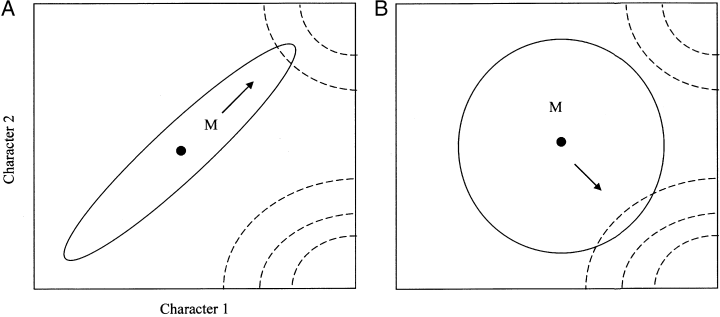
Are there analogs of this kind of behavior for quantitative traits? Various authors such as Wallace Arthur (below is Fig. 1 from his 2004 article) have supposed that the interaction of asymmetric variability with selection gradients can result in preferences for one fitness peak over another. Arthur refers to the asymmetry in panel A as “developmental bias”.
A similar figure from Schluter (2024) is shown below. In panel B, the population is roughly equidistant from peaks L (left) and R (right), with roughly orthogonal paths to the 2 peaks. The ellipse of variability is strongly oriented toward R, reflecting positive covariance of traits 1 and 2, and this bends the expected trajectory toward R. Note that this is a symmetric landscape (L and R are equal peaks), so that if we relocate the population to a position reflected across the LR line, the interaction of asymmetric variation and selection will shift the trajectory toward L instead of R. Thus the interaction of variation and selection produces a relative orientation, but does not itself favor L or R.
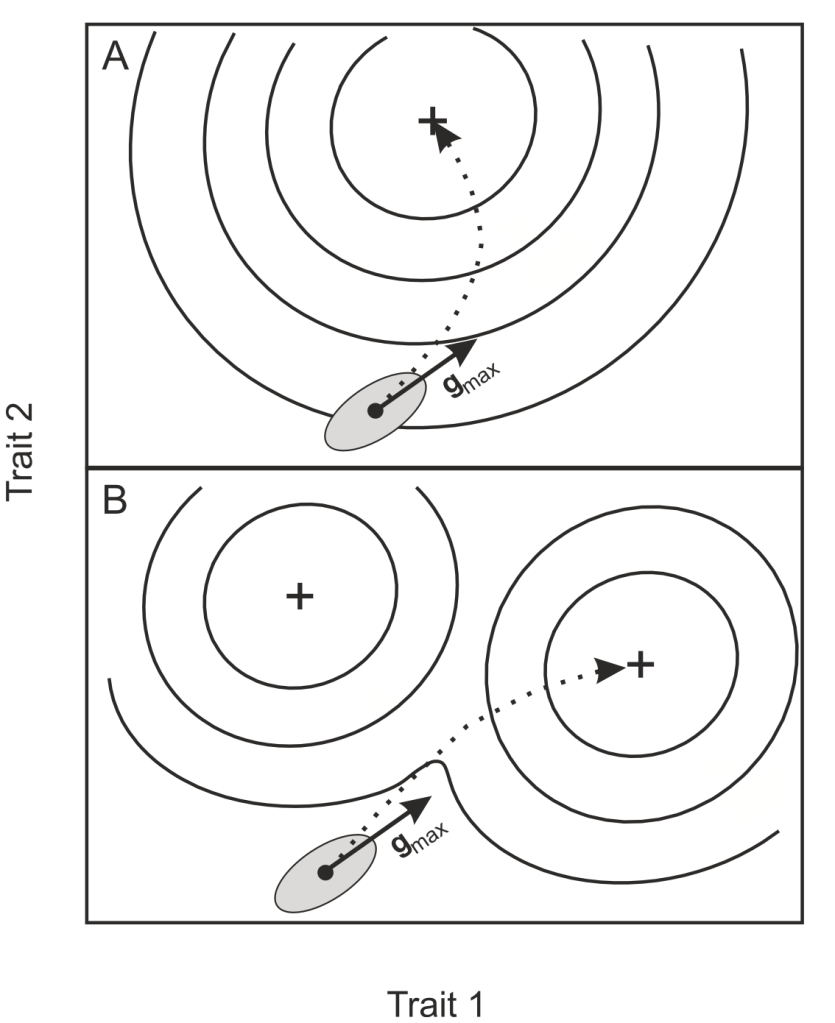
This seems like a reasonable conjecture, but there is no published formal theory on this. Why hasn’t this very basic question been solved? For various reasons, the focus of theoretical work in EQG lies elsewhere. But even if we had this theory, we would still have a gap to cover between what is known about the effect of differential variability in EQG, and what is known about the effect of arrival bias for evolution in discrete spaces. The two bodies of theory differ in their assumptions about standing variation and discrete vs. continuous traits. Most importantly, the theory of arrival bias covers the potential for a directional bias to impose a local directional preference or long-term trend on evolutionary change— and a directional bias is something different from an asymmetry in variability.
In conclusion, the situation is complex. EQG and arrival bias both have important things to say about how variability can influence evolution, but these two bodies of theory are mostly saying non-comparable things about non-comparable circumstances. Ultimately, we can make the same kind of statement we made previously (in regard to constraints or contingency) about what we can learn from the prior literature: one could read 100 years of literature on quantitative traits, and a few decades of literature that pertains to differential trait variability, and not learn what has been proven (theoretically or empirically) to be true about arrival bias, because they are not the same thing.
Summary
Arrival bias may be misconstrued as neutrality, contingency, constraints, mutation pressure, directed mutation, evolvability, or differential variability. These misapprehensions emerge during a triage process in which scientists respond to novel claims by mapping them to other more familiar claims (or by dismissing them as untenable).
We can understand misapprehension as a strategy to relieve psychic dissonance by placing a potentially threatening idea into a safe, known category. These gut reactions are strongly shaped by dichotomies established in prior disputes. That is, rather than addressing the genuine challenge raised by arrival bias, scientists are often fighting the last war— against Lamarckism, orthogenesis, “mutationism”, or neutrality.
These misapprehensions will continue to happen even if they are obviously wrong, so long as scientists are making individual “triage” decisions— a rapid process that reflects gut instincts rather than thoughtful deliberation—, or are influenced by gatekeepers spreading doubt or misinformation. This combination of triage and gatekeeping will keep the idea of arrival bias out of evolutionary discourse, unless and until there are effective champions to explain what makes the idea distinctive and important


Leave a Reply